

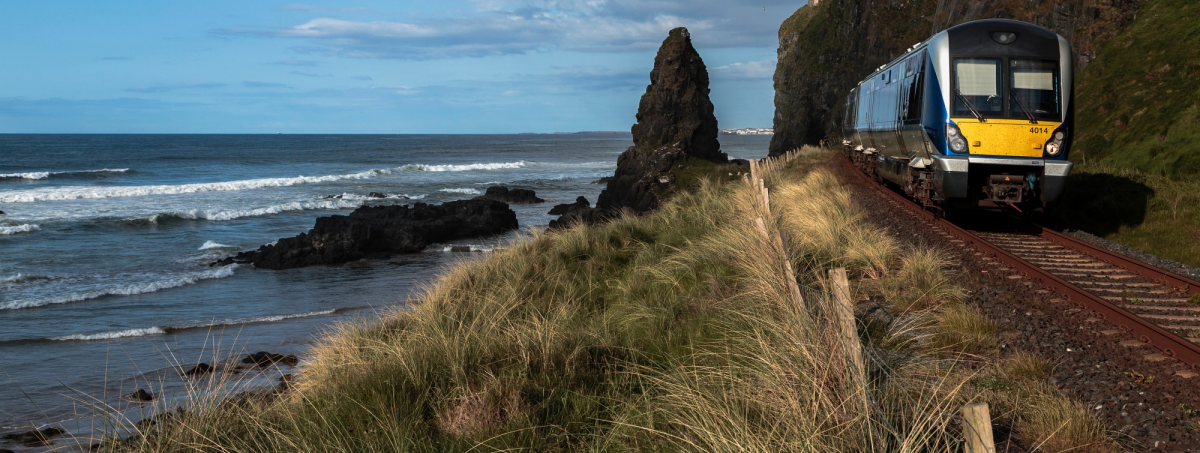
Ireland’s railways are at the start of a generational transformation and the procurement opportunity it creates is one of the largest in the island’s infrastructure history. Writing in Rail Engineer, David Shirres reports that the All-Ireland Strategic Rail Review (AISRR) proposes doubling rail’s passenger market share through electrification, double-tracking, and new lines at an indicative cost of £30 billion at 2023 prices over 25 years, with approximately 75% funded by the Republic of Ireland. The ambition is grounded in a striking gap: rail accounts for just 1.6% of distance travelled in Ireland, compared with 9% in the United Kingdom, despite 64 million passenger journeys recorded in 2024.
The commercial case is already being written by early investment. Since Belfast Grand Central Station opened in October 2024 following a £340 million investment, cross-border journeys on the Enterprise service between Dublin and Belfast have increased by 57%. On the Belfast to Derry corridor, an hourly service introduced in 2017 following £50 million in track and signalling investment has driven a 78% rise in passenger numbers. Targeted capital investment in Irish rail consistently generates measurable demand growth.
For procurement leaders, the AISRR represents a sequenced pipeline rather than an aspirational strategy. The Rail Project Prioritisation Strategy, published in December 2024 with support from the European Investment Bank, identifies near-term and longer-term priorities across both jurisdictions. Immediate activity includes station enhancements, passing loops, Cork suburban service upgrades, the Foynes freight line, and the DART+ programme. Iarnrod Eireann and Translink have already selected Stadler Flirt trainsets to replace the 30-year-old Enterprise fleet.
Three procurement considerations follow. Supply chain development is most urgent: a rolling electrification programme reduces unit costs and builds supplier maturity over time, making early market engagement a competitive advantage. The Prioritisation Strategy explicitly encourages early contractor involvement, creating opportunities for tier-one and specialist contractors to shape specifications ahead of formal tender. The cross-border structure also rewards suppliers operating across both Irish and Northern Irish regulatory frameworks.
Three actions will position procurement teams effectively. Organisations with rail, electrification, or civil engineering capability should register interest with Iarnrod Eireann and Translink now, as supply chain visibility is an explicit programme objective. Procurement functions within public bodies should map requirements for rail-adjacent services, including facilities management around station upgrades, against published project timelines. Procurement leaders should treat the AISRR as an active pipeline, as contracts for near-term projects are already advancing.
Ireland’s railway renaissance is generating real returns and the AISRR provides the framework to accelerate them. For procurement professionals with the capability and foresight to engage early, a £30 billion programme over 25 years, sequenced and supported by the European Investment Bank, represents one of the most visible and well-structured procurement opportunities on the island.
(The views expressed by the writer are his/her own and do not necessarily reflect the views or positions of BusinessRiver.)










.png)

