

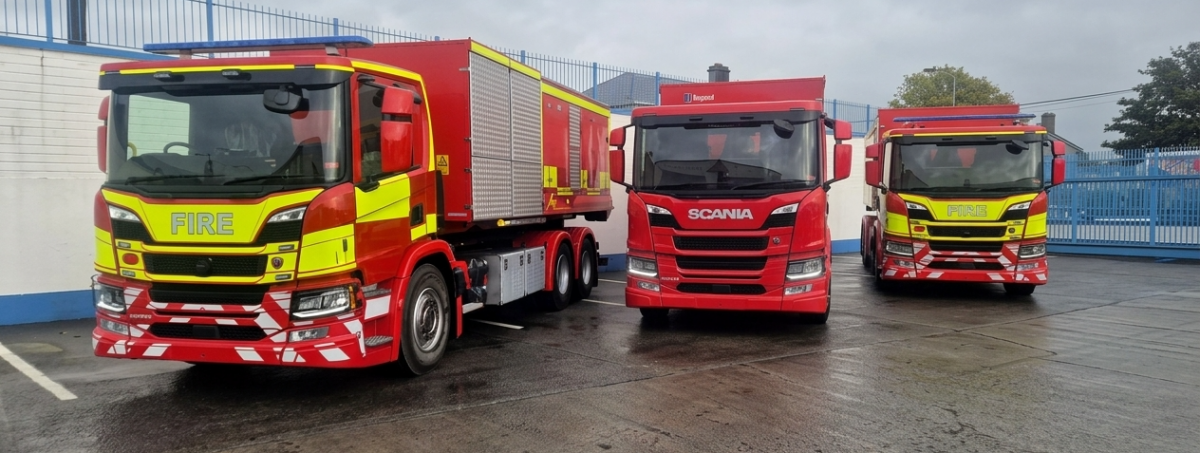
Ireland’s investment in high-capacity emergency pumps is demonstrating how coordinated public procurement can build national resilience while giving fire and rescue services access to specialist equipment for major incidents.
The first five high-capacity pump appliances have arrived in Ireland as part of the National High-Capacity Pump Programme, with one allocated to Cork City. Cork Beo reported that each appliance represents an investment of approximately €1.1 million, with the equipment designed for major flooding, large fires and other complex emergencies.
The programme has its foundations in a coordinated procurement involving five local authorities: Galway City Council, Dublin City Council, Cork City Council, Westmeath County Council and Galway County Council. The eTenders procurement record shows that the open procedure established a framework for high-capacity pumps and a prime mover, with an awarded value of approximately €5.04 million and a framework running to 2031.
For National Procurement teams, the model is significant because it moves beyond individual councils purchasing specialist equipment independently. Pooling demand across local authorities creates a larger, structured procurement opportunity while allowing the resulting assets to form part of a nationally coordinated emergency response capability. The framework was evaluated using the Most Economically Advantageous Tender approach, balancing procurement considerations beyond price alone.
The equipment also illustrates the wider value that strategic procurement can deliver. High-capacity pumping technology gives emergency services greater ability to move large volumes of water during severe flooding and can also support firefighting and other complex operations. The first five appliances are being distributed across Cork, Dublin, Galway, Monaghan and Westmeath, creating geographically distributed capability that can be deployed where it is most needed. The Department of Housing, Local Government and Heritage is overseeing the wider investment in specialist emergency response capability, equipment and training.
There is also a clear lifecycle consideration. The new appliances still require final fit-out, crew training and commissioning before becoming fully operational, highlighting that public procurement of specialist equipment extends beyond the initial purchase. Training, maintenance, operational readiness and deployment arrangements all contribute to the value ultimately delivered by the investment.
For the sector, the programme provides a strong example of how public procurement can be used to create national capability rather than simply acquire individual assets. Coordinated purchasing across local authorities can generate economies of scale, establish longer-term supply arrangements and ensure specialist resources are distributed strategically. As Ireland invests in resilience against increasingly complex emergency events, procurement is becoming an important part of how that capability is designed and delivered.
Source: Cork Beo / eTenders / Department of Housing, Local Government and Heritage









.png)

